
Safety Files South Africa | Requirements, Templates & Guides
Safety File Requirements South Africa (Complete Compliance Guide)
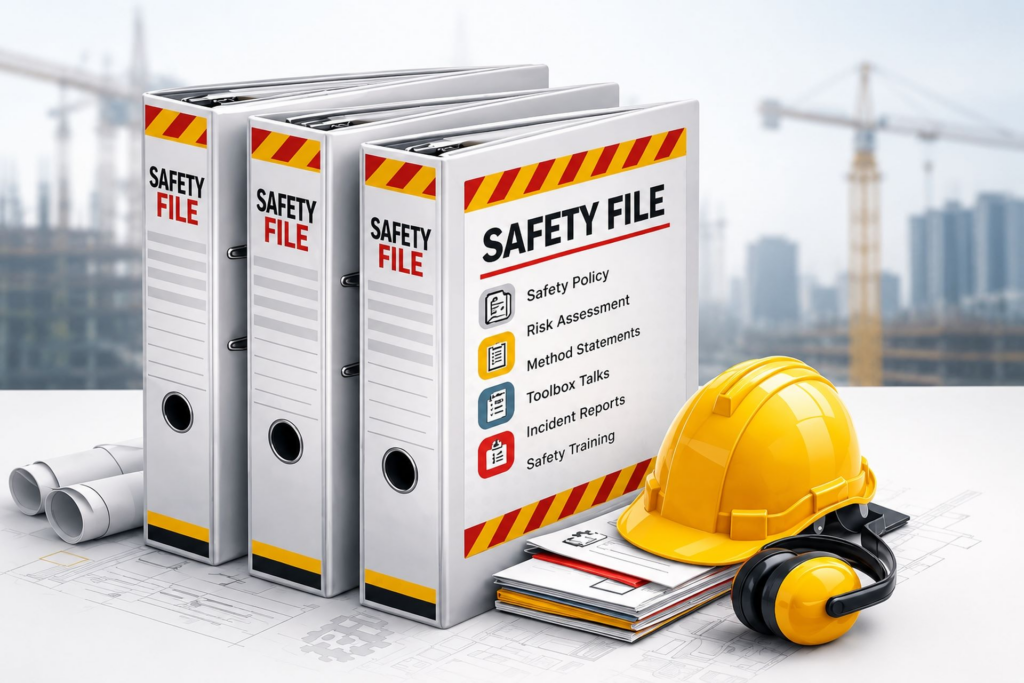
Safety File Requirements South Africa
A construction Safety File must contain the health and safety documentation required by the Occupational Health and Safety Act 85 of 1993, the Construction Regulations 2014 and the other regulations applicable to the project activities.
There is no single universal list that applies unchanged to every contractor. The contents must be determined from the client’s health and safety specification, the contractor’s scope, the risk assessments, the workforce, plant and equipment, substances, work methods and the legal duties triggered by the work.
Current legal status
The Construction Regulations 2014 remain the operative regulations used for this guide. Draft Construction Regulations were published for public comment in March 2025 with the stated intention of replacing the 2014 Regulations. Draft text must not be represented as enforceable law unless and until replacement regulations are formally promulgated and commenced.
Who must keep a Safety File?
Principal contractor: Construction Regulation 7(1)(b) requires the principal contractor to open and keep a health and safety file on site. The client must ensure that the file is kept and maintained by the principal contractor under Construction Regulation 5(1)(s).
Contractor: Construction Regulation 7(2)(b) requires a contractor, before performing construction work, to open and keep a health and safety file on site. Where a contractor appoints another contractor, further duties apply under Construction Regulation 7(3).
Completion: Construction Regulation 7(1)(e) requires the principal contractor to hand a consolidated health and safety file to the client at completion, including the additional records identified in that provision.
Core Safety File sections
1. Project and contractual records
Project particulars, scope of work, appointment letters, relevant agreements, client specification, applicable risk information, permit or notification records where required, and document-control details.
2. Health and safety planning
The principal contractor’s or contractor’s site-specific health and safety plan, together with supporting policies, procedures, emergency arrangements and applicable specialist plans.
3. Risk management
Written appointment of the competent risk assessor, risk assessments meeting Construction Regulation 9, method statements, safe work procedures, monitoring plans, review arrangements and evidence that workers were informed, instructed and trained.
4. Legal appointments and competence
Project-specific appointments, signed acceptance, clearly defined duties, qualifications, training, experience and other evidence supporting competence where required.
5. Employee records
Employee list, identity and employment records where lawfully required, project induction, medical certificates of fitness, training and authorisation records.
6. Plant, tools, equipment and access systems
Inventory, operating information, inspections, tests, maintenance records and competent-person appointments relevant to the actual plant, machinery, tools, ladders, scaffolding, lifting equipment or other systems used.
7. Hazardous substances and occupational hygiene
Chemical inventory, current safety data sheets, risk assessments, storage and handling controls, exposure monitoring or medical surveillance records where applicable.
8. PPE and fall protection
PPE assessment, issue and inspection records. Where a fall risk exists, the Fall Protection Plan, medical fitness, training, equipment inspection/testing/maintenance and rescue arrangements required by Construction Regulation 10.
9. Emergency and incident management
Emergency contacts, site-specific response procedures, first-aid arrangements, fire arrangements, drills, incident records, investigations, statutory reporting and corrective actions.
10. Inspections, consultation and monitoring
Daily, weekly or monthly inspection records relevant to the work; toolbox talks; health and safety representative or committee records where applicable; audit reports and close-out evidence.
Documents that must be site- or project-specific
- Health and Safety Plan
- Scope and work sequence
- Risk assessments and method statements
- Fall Protection Plan and rescue arrangements
- Emergency procedures and contacts
- Appointments and organogram
- Induction content
- Inspection registers selected for the actual equipment and work
- Monitoring and review arrangements
Common legal and operational errors
- Stating that only the principal contractor requires a file
- Using a generic plan that does not respond to the client specification
- Including non-applicable appointments or registers
- Missing signed acceptance of appointments
- Treating a training certificate as automatic proof of competence without considering knowledge, training, experience, qualifications and legal familiarity
- Expired medical certificates, training or compensation records
- Risk assessments that do not match the actual work, equipment or access method
- No rescue plan for fall-arrest work
- Registers inserted in the file but never completed
- Failing to review the file when work, design, personnel, equipment or risks change
Safety File review checklist
- Does every document show the correct project, client, contractor and scope?
- Are all legal references current and correctly cited?
- Do appointments match the actual management structure and work?
- Is the evidence supporting competence attached and valid?
- Do risk assessments cover the real activities and interfaces?
- Are inspections being completed at the required frequency?
- Are changes, incidents and audit findings reflected in updated documents?
- Can an auditor quickly locate each required record through the index?
Need a scope-specific file review or complete Safety File compilation? Submit the client specification and current file for a defined review and quotation.