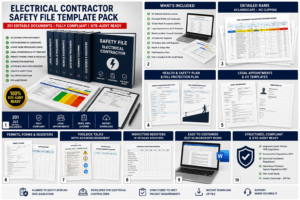
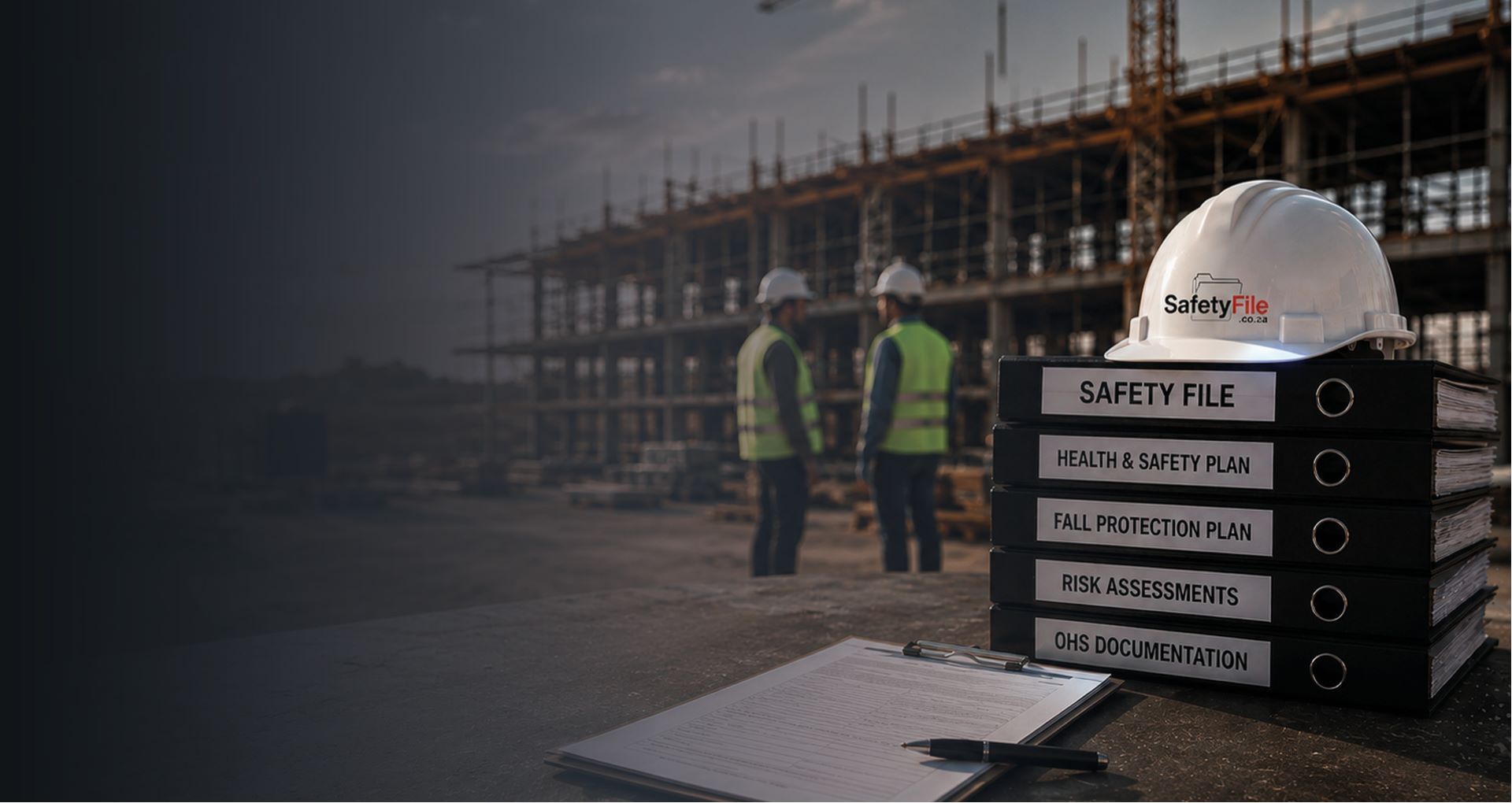
A Safety File (often referred to as a Contractor Health and Safety File) is a legally required collection of documents that demonstrates your construction site is properly managed, compliant and safe in accordance with the Occupational Health and Safety Act 85 of 1993 and the Construction Regulations 2014.
In practical terms, it is the structured record of all mandatory safety documentation for your project. This typically includes risk assessments, method statements, legal appointments, medical certificates, induction records, inspection registers and emergency procedures, all organised and available for site approval or Department of Employment and Labour inspection.

Why Is a Safety File Important?
- It is a legal requirement – Contractors and employers must maintain a compliant Safety File under South African legislation.
- It proves due diligence – Demonstrates that reasonably practicable steps have been taken to ensure a safe working environment.
- It prevents project disruption – Without an approved Safety File, access to site can be refused or work stopped.
- It reduces liability risk – Proper documentation supports legal defence and regulatory compliance if an incident occurs.
In Simple Terms
If you are a contractor or subcontractor, your Safety File is your authorisation to operate on site. Without it, you risk:
- Project delays
- Fines and enforcement action
- Site closure
- Legal and financial consequences
How We Assist
We prepare fully compliant, project-specific Safety Files that:
- Meet OHS Act and Construction Regulation requirements
- Are structured for first-time site approval
- Align with client and principal contractor expectations
- Support ongoing compliance throughout the duration of your project
Get your Safety File done correctly from the start — compliant, organised and ready for site approval.
What Must Be Included in a Compliant Safety File?
A compliant Safety File must contain all documentation required under the Occupational Health and Safety Act and the Construction Regulations 2014. While requirements may vary depending on project scope and risk profile, a properly structured file should typically include:
- Legal Appointments – Written appointments for the employer, supervisors, construction manager, safety officer and other legally designated persons.
- Risk Assessments – Baseline and task-specific risk assessments identifying hazards and control measures.
- Method Statements – Detailed safe work procedures for high-risk activities such as working at height, excavation, lifting operations and electrical work.
- Medical Certificates of Fitness – Valid proof of medical fitness for all personnel exposed to construction risks.
- Training and Induction Records – Evidence of competency, toolbox talks, inductions and relevant certification.
- Registers and Inspection Records – Equipment inspections, scaffold registers, ladder registers, PPE issue registers and incident logs.
- Emergency Preparedness Documentation – Emergency procedures, evacuation plans, contact lists and first aid arrangements.
- Proof of Compliance – Public liability insurance, COID registration, letters of good standing and contractor agreements where applicable.
The absence of any of these documents can result in non-compliance findings, enforcement notices or site shutdown. A properly compiled Safety File ensures that all required documentation is present, current and readily available for inspection.