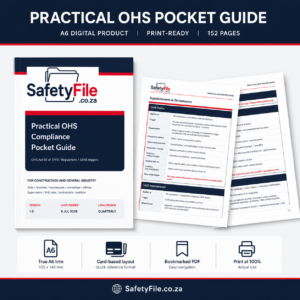
Practical OHS Compliance Pocket Guide South Africa – A6 PDF
R199.00
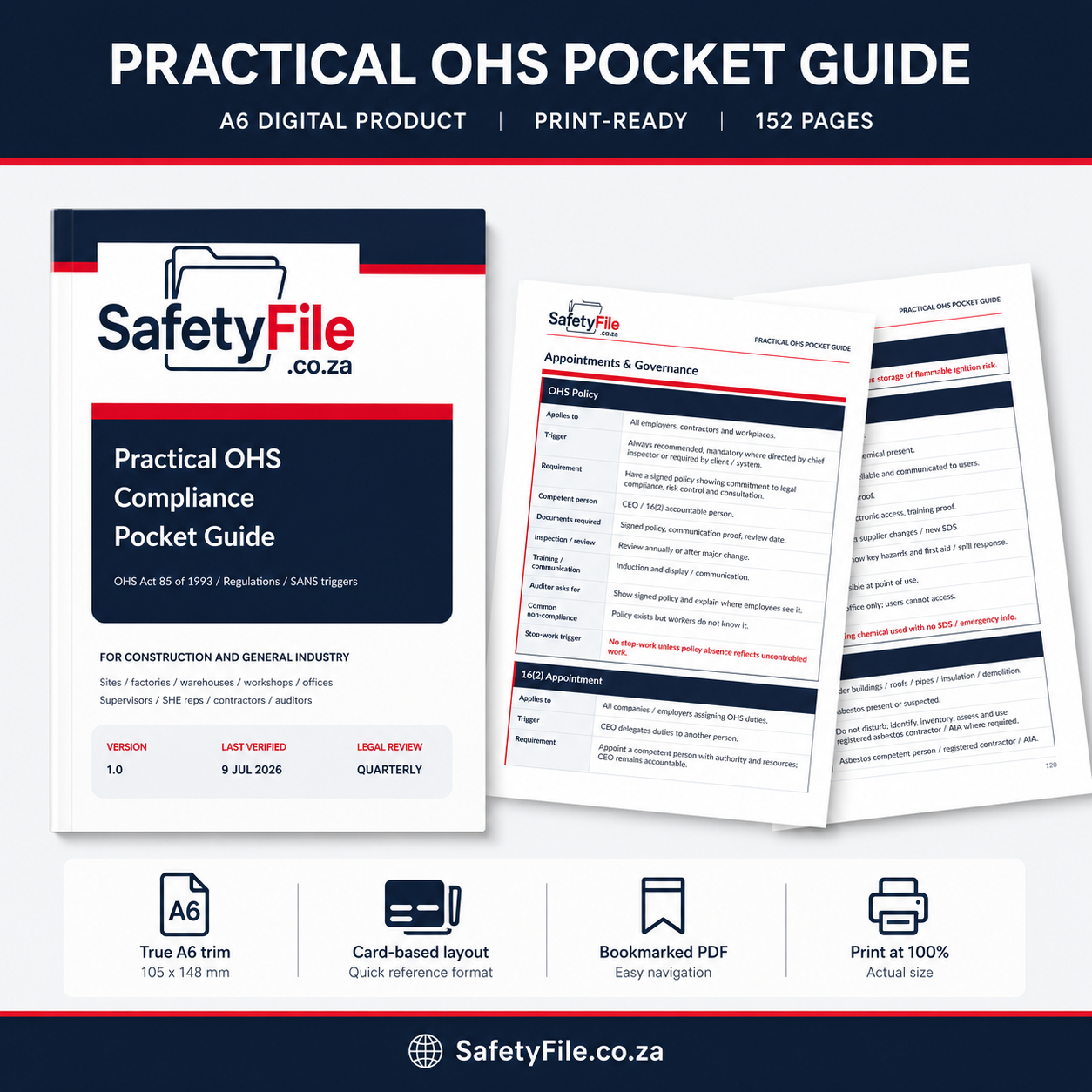
Keep essential South African OHS compliance guidance close at hand with this practical 152-page A6 pocket guide.
The guide converts important requirements of the Occupational Health and Safety Act 85 of 1993, applicable regulations and common SANS triggers into plain, practical workplace actions.
It includes appointment triggers, workplace checklists, inspection frequencies, stop-work rules and quick-reference compliance cards for construction sites, factories, warehouses, workshops, offices, retail workplaces and contractor activities.
Practical OHS Compliance Pocket Guide South Africa
The Practical OHS Compliance Pocket Guide South Africa is a compact workplace reference for supervisors, contractors, employers, health and safety representatives, SHE officers, safety practitioners and site auditors.
Instead of searching through lengthy legislation while standing on site, users can quickly identify:
- When an OHS requirement applies.
- What appointment or competent person is required.
- Which documents and records should be available.
- What an auditor or inspector is likely to request.
- How frequently equipment or workplace controls should be inspected.
- When an unsafe activity should be stopped.
The guide is presented in a true A6 pocket-book format measuring 105 × 148 mm. It can be used digitally on a phone, tablet or computer or printed at actual size as a practical site reference.
What is included
OHS Act 85 of 1993
A plain-English, section-by-section overview of the Occupational Health and Safety Act, including practical workplace duties and the records normally required to demonstrate implementation.
Topics include:
- Employer duties.
- Employee duties.
- Duties towards members of the public.
- Manufacturer and supplier duties.
- Health and safety policies.
- Chief executive officer responsibilities.
- Health and safety representatives.
- Health and safety committees.
- Incident reporting.
- Contractor and mandatary control.
- Inspector powers.
- Legal records and evidence.
Employee and appointment triggers
A practical trigger table covering common employee-number and activity-based requirements, including:
- First aid boxes.
- Trained first aiders.
- Health and safety representatives.
- Health and safety committees.
- Contractor control.
- Construction work requirements.
- Hazardous chemical controls.
- Noise exposure.
- Pressure equipment.
- Lifting machinery.
- Electrical installations.
- Asbestos.
- Work at height.
Regulation summaries
The guide provides practical summaries of commonly applicable South African OHS regulations, including:
- General Administrative Regulations.
- General Safety Regulations.
- Facilities Regulations.
- Construction Regulations, 2014.
- Driven Machinery Regulations.
- Electrical Installation Regulations.
- Electrical Machinery Regulations.
- Pressure Equipment Regulations.
- Hazardous Chemical Agents Regulations.
- Hazardous Biological Agents Regulations.
- Asbestos Abatement Regulations.
- Lead Regulations.
- Ergonomics Regulations.
- Noise exposure requirements.
- Physical agent requirements.
- Major Hazard Installation requirements.
- Explosives requirements.
- Commercial diving requirements.
- Specialist competency requirements.
Each topic explains the basic duty, when it is triggered and the documentation, appointment, inspection or competency proof normally required.
SANS trigger guide
The guide does not reproduce copyrighted SANS standards. It explains when commonly applicable standards may be triggered and what supporting proof should be available.
Common topics include:
- Electrical installations.
- Hazardous electrical locations.
- Petroleum installations.
- Scaffolding.
- National Building Regulations.
- Chemical classification and labelling.
- Dangerous goods.
- LPG.
- Fire extinguishing equipment.
- Pressure equipment.
- Safety helmets.
- Eye protection.
- Hearing protection.
- Fall-arrest harnesses.
- Protective gloves.
- Safety footwear.
- ISO 45001 management systems.
The official standard must still be obtained and applied where it is incorporated into legislation, specified by a client or designer, required by an engineer or necessary for technical compliance.
Workplace compliance checklists
Quick-reference checklists are provided for:
- Construction sites.
- Factories.
- Workshops.
- Warehouses.
- Logistics operations.
- Offices.
- Retail workplaces.
These checklists help supervisors identify missing appointments, risk controls, inspections, training and compliance records before an audit or inspection.
Inspection frequency guide
The inspection guide covers practical inspection and review frequencies for common workplace controls and equipment, including:
- First aid boxes.
- Fire extinguishers.
- Portable electrical tools.
- Ladders.
- Harnesses and lanyards.
- Scaffolding.
- Excavations.
- Forklifts.
- Mobile plant.
- Lifting tackle.
- Pressure equipment.
- Chemical stores.
- Health and safety representative inspections.
- Health and safety committee meetings.
Where legislation, a manufacturer, an engineer or a client specifies a stricter frequency, the stricter requirement must be followed.
Stop-work guide
The stop-work section identifies high-risk conditions requiring the unsafe activity to be stopped until suitable controls have been implemented.
Examples include:
- High-risk work without a risk assessment.
- Work at height without fall protection or rescue arrangements.
- Unsafe or uninspected scaffolding.
- Unprotected excavations.
- Live electrical hazards.
- Missing machine guards.
- Maintenance without lockout and isolation.
- Untrained mobile plant operators.
- Unlabelled hazardous chemicals.
- Suspected asbestos disturbance.
- Confined-space entry without testing and rescue.
- Hot work without fire controls.
- Uncontrolled exposure of the public or other contractors.
Field compliance cards
The field cards provide rapid guidance on individual OHS subjects.
Each card identifies:
- Where the requirement applies.
- The trigger.
- The practical requirement.
- The competent person.
- Required documentation.
- Inspection or review frequency.
- Training and communication.
- What an auditor will request.
- Common non-compliance.
- Stop-work conditions.
Topics include appointments, contractor control, safety files, first aid, PPE, induction, risk assessments, emergency planning, chemicals, asbestos, noise, machinery, forklifts, lifting, pressure equipment, electrical work, work at height, scaffolding, excavations and demolition.
Who should use this guide?
This guide is suitable for:
- Construction contractors and subcontractors.
- Principal contractors.
- Employers.
- Factory and warehouse managers.
- Workshop supervisors.
- Facilities and maintenance teams.
- Health and safety representatives.
- Health and safety committee members.
- SHE officers.
- Safety practitioners.
- Site supervisors and foremen.
- Contract managers.
- Internal auditors.
- Small businesses managing workplace OHS compliance.
Product format
- Format: Digital PDF.
- Pages: 152.
- Finished size: A6.
- Dimensions: 105 × 148 mm.
- Language: South African English.
- Navigation: PDF bookmarks included.
- Printing: Print at 100% or “Actual Size”.
- Use: Digital viewing or physical printing.
- Editable: No.
- Physical delivery: None.
- Version: 1.0.
- Last verified: 9 July 2026.
Printing instructions
For the correct pocket-book size:
- Download the PDF.
- Select A6 paper where available.
- Select Actual Size or 100% scale.
- Do not select “Fit to Page”.
- Print double-sided and bind or staple according to your preferred finishing method.
A commercial printer may also print and bind the guide as an A6 booklet.
Important compliance notice
This guide is a practical compliance aid and does not replace:
- The official Occupational Health and Safety Act.
- Promulgated regulations.
- Government gazettes.
- Incorporated standards.
- Official SANS publications.
- Client health and safety specifications.
- Engineer or designer requirements.
- Approved inspection authority reports.
- Competent professional advice.
- Legal advice.
Legislation and incorporated standards may be amended. Users must confirm that the legal requirements applicable to their workplace, activity and date of use remain current.
Draft legislation must not be treated as enforceable law until it has been finally promulgated.
Licence and copyright
Copyright © 2026 Safety File (Pty) Ltd. All rights reserved.
The purchaser may download and print the guide for their own internal workplace use. The guide may not be:
- Resold.
- Rebranded.
- Redistributed as a separate product.
- Uploaded to a public website or shared drive.
- Supplied to another business for commercial use.
- Copied and incorporated into another commercial publication.
- Used to create a competing product.
Purchase of this product does not transfer copyright or ownership of the content.
Related products