
Safety File Templates South Africa | Download & Compliance Documents
How to Compile a Construction Safety File in South Africa | Free Guide
How to Compile a Construction Safety File in South Africa
If you need to compile a construction safety file and do not know where to start, you are not alone. For many contractors, subcontractors, and site managers, the biggest challenge is not understanding that a safety file is required. It is knowing what documents to include, how to organise them, and how to structure the file so it meets client requirements and is ready for site audits or inspections. The free guide on Safety File (Pty) Ltd is designed to do exactly that. It explains how to build a compliant construction safety file from zero, in plain language, and shows what documents are required and how to organise them correctly.
What Is a Construction Safety File?
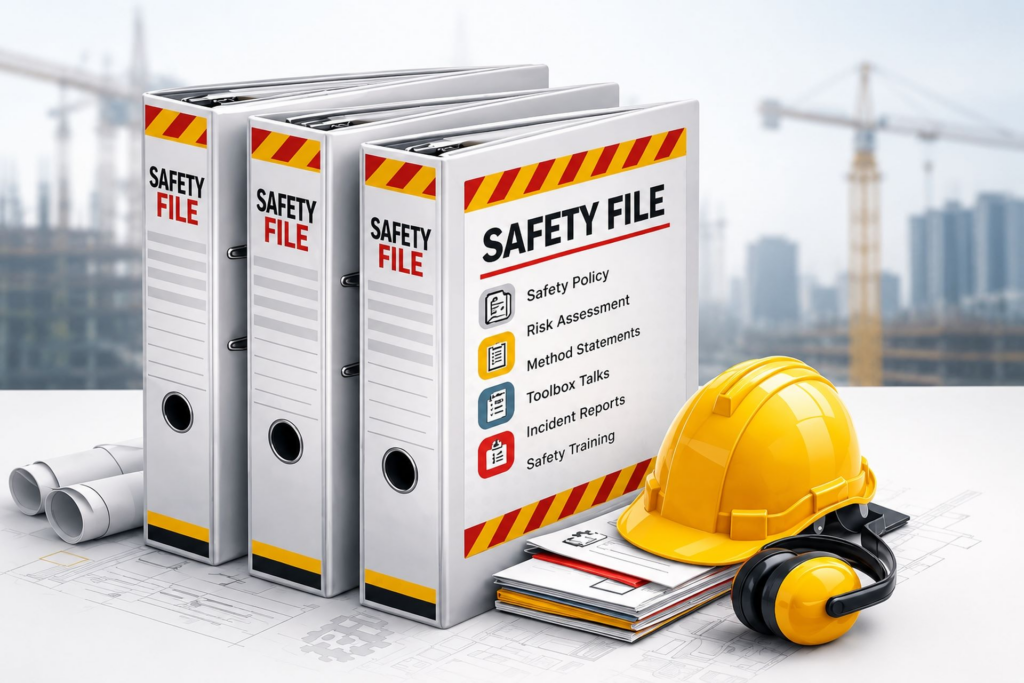
A construction safety file is a structured set of documents that shows how a contractor manages health and safety risks on a construction project. According to the product page, the file typically includes company compliance documents, legal appointments, risk assessments, safety procedures, training records, inspection registers, and incident management records. The same page states that clients and principal contractors usually require the file before work begins to confirm compliance with South African health and safety requirements.
In practical terms, a properly compiled file helps you prepare for:
-
client review
-
contractor approval
-
site access
-
inspections
-
audits
-
project mobilisation
A weak or disorganised file can delay all of that. Paperwork has a special talent for becoming urgent five minutes before access is denied.
What Is a Construction Safety File?
The Safety File guide states that construction safety files are required for:
-
principal contractors
-
subcontractors
-
construction companies
-
self-employed trades working on construction sites
The page also notes that, in many cases, the file must be submitted and approved before access to site is granted. That makes the file more than a compliance folder. It becomes a practical requirement for getting work started.
What Documents Are Usually Required in a Construction Safety File?
The guide page gives a clear outline of the types of documents commonly included in a construction safety file. These usually include: company documentation, legal appointments, risk management records, plans and policies, employee compliance records, PPE and equipment records, and incident management documents. The page specifically lists examples such as a Letter of Good Standing, Tax Clearance Certificate, Public Liability Insurance, baseline and task-specific risk assessments, a Health and Safety Plan, Fall Protection Plan, Emergency Response Plan, Environmental Policy, medical certificates of fitness, training records, induction registers, PPE issue registers, inspection checklists, incident registers, investigation reports, and injury records.
That means the file is not just a single document. It is a structured compliance pack that needs to be complete, relevant, and organised.
Step-by-Step Process to Compile a Construction Safety File
The product page sets out a practical six-step structure for compiling the file:
-
Gather all required company compliance documents.
-
Obtain client specifications and contractor appointment documentation.
-
Prepare project-specific risk assessments and safety plans.
-
Compile employee competency and training records.
-
Organise policies, procedures, and inspection registers.
-
Structure the file using a clear index and document naming system.
That sequence is useful because it turns a messy admin task into a process you can actually follow. The guide also says it explains where to obtain the required documents and how to organise them correctly, which is the part most people stumble over.
What You Get in the Free Guide
The free guide is described as a PDF guide only, with no templates included. It explains:
-
what each document in a safety file is
-
where to obtain it
-
what information must be included
-
how to structure and file it correctly
-
when documents must be updated
The page also states that the guide provides a clear safety file index structure to help users organise both physical and digital files. After using it, users should be able to compile a construction safety file from zero, meet client compliance requirements, prepare files for site inspections and audits, and maintain organised digital and physical safety files.
That makes it a useful starting point for contractors who need clarity before they start buying templates or outsourcing the full compilation process.
Why Download the Guide First?
Downloading the guide first makes sense if you want to:
-
understand the full structure before compiling the file
-
avoid missing key documents
-
prepare for client review more efficiently
-
reduce delays caused by incomplete submissions
-
decide whether you need a guide, templates, or a done-for-you file
Safety File (Pty) Ltd also links related products on the same page, including Construction Safety File (Templates), Legal Appointment Letters-Construction, Risk Assessments, Safety File – site specific, and Health & Safety Plan, which suggests a sensible path from free educational content to paid compliance support where needed.
Download the Free Construction Safety File Guide
If you need a practical starting point, this is the correct page to use:
Download the free guide here: How to Compile a Construction Safety File – Free OHS Act Guide (SA)
Final Word
A construction safety file does not need to be mysterious, but it does need to be structured properly. Based on the product page, this free guide is aimed at contractors, subcontractors, and site managers who need a plain-language explanation of what goes into the file, where to get the documents, and how to organise everything for compliance, audits, and client approval.
If your goal is to get the file right the first time, start with the guide. It is free, practical, and a lot cheaper than losing site access because your paperwork looks like it was assembled during a panic attack.
FAQ
Is the guide free?
Yes. The product page lists the guide at R0.00.
Does the guide include templates?
No. The page states that it is a PDF guide only and that no templates are included.
Who is the guide for?
It is aimed at contractors, subcontractors, and site managers who need to compile a construction safety file.
What does the guide explain?
It explains what documents are required, where to get them, how to structure the file, and when documents must be updated.
Is the file needed before site access?
The page states that most clients require the file to be submitted and approved before access to site is granted.